
Volumes
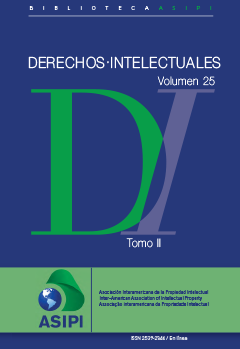
Intellectual Rights 25, volume II
Information
Type
Libro
Version
2
File Size
2.64 Mb
Published Date
01/12/2020
Categoría
Volumes
Authors
ASIPI
Attached Files:
Array ( [icon] => [view_count] => 310 [download_count] => 49 [link_label] => Download [version] => 2 [quota] => [access] => Array ( [0] => guest ) [package_size] => 2.64 Mb [publish_date] => [expire_date] => [avail_date_ts] => [avail_date] => [expire_date_ts] => [download_limit_per_user] => [ID] => 1692 [post_author] => 3154 [post_date] => 2020-12-04 00:12:47 [post_date_gmt] => 2020-12-04 00:12:47 [post_content] =>Intellectual Rights 25, volume II
Definitely ASIPI is a living organization that works hard and takes challenges as opportunities. Not in any other way can we interpret the fact that each year we receive more articles for our now emblematic magazine “Intellectual Rights”. This time we reached number 25, we celebrated the silver anniversary and we received a record number of papers –21– that deal with all kinds of current issues for the subject that unites us: intellectual property. In this issue the reader will be able to find information on traditional and no less important topics, analysis on cutting-edge topics that we are just trying to understand and studies that, although they seem to interest only one country, ultimately concern us all. - Elisabeth Siemsen [su_accordion] [su_spoiler title="Protección de los datos personales relacionados con la salud: estudio a propósito del Covid-19 por Maritza Reátegui Valdivieso, Daniela Supo Calderón y Crisbeth Vigo Florián" open="no" style="default" icon="plus" anchor="" anchor_in_url="no" class=""] Regarding the processing of personal data of patients with Covid–19 in Peru, this academic article analyzes the implications of Peruvian regulation on personal data related to health. In this sense, the authors seek to contribute to the debate about the balance between the health rights and the protection of personal data. [/su_spoiler] [su_spoiler title="Because don’t exist scape anymore by Mario Filipe Cavalcanti de Souza Santos" open="no" style="default" icon="plus" anchor="" anchor_in_url="no" class=""] This article aims to demonstrate that in Brazil for many years there has been a robust regulatory framework applicable to the protection of privacy and personal data of consumers, which operates even when the General Data Protection Law (LGPD) has not begun to rule. [/su_spoiler] [su_spoiler title="Porque não há mais escapatória por Mario Filipe Cavalcanti de Souza Santos" open="no" style="default" icon="plus" anchor="" anchor_in_url="no" class=""] This article aims to demonstrate that in Brazil for many years there has been a robust regulatory framework applicable to the protection of privacy and personal data of consumers, which operates even when the General Data Protection Law (LGPD) has not begun to rule. [/su_spoiler] [su_spoiler title="La denominación de origen en Bolivia y Brasil: panorama de su evolución, el singani y la cachaça, negociación Mercosur – UE por Edwin Urquidi y Luciana Noronha" open="no" style="default" icon="plus" anchor="" anchor_in_url="no" class=""] This article offers an overview of the normative and practical evolution of appellations of origin in Bolivia and Brazil, also describing the progress made regarding the protection of the emblematic alcoholic spirits of these two countries, SINGANI and CACHAÇA, their significance from the integration blocs of which they are part of the Andean Community of Nations (CAN) and the Southern Common Market (MERCOSUR) respectively, as well as the status of the current negotiation process carried out by MERCOSUR and the European Union as regional trade blocs and where the issue of appellation of origin is involved. Moreover, this article recognizes the common features of their territories and indigenous and Afro-American population, such as traditional knowledge, collective rights and border products that would make possible the creation of a binational declaration for appellation of origin. [/su_spoiler] [su_spoiler title="La interrelación entre el derecho de autor y las marcas y el instituto de la cosa juzgada a la luz de lo resuelto por la Corte Suprema de Justicia argentina en el caso “El Eternauta” por Laura Achaval" open="no" style="default" icon="plus" anchor="" anchor_in_url="no" class=""] Drawing from a decision rendered by the Supreme Court of Argentina in the case “El Eternauta”, the author outlines an analysis of the legal concept of res judicata and the interrelation between copyright and trademark law. By examining relevant legislation, academic legal opinion and case law, she discusses several aspects of the res judicata principle, such as content, constitutional scope and public policy nature, insofar as the stability of jurisdictional decisions constitutes a necessary prerequisite for legal certainty. As for the interrelation of copyright and trademark law, the author analyzes the protection afforded by both academic legal opinion and case law to works’ titles and main characters and further proposes additional protection based on her experience litigating the case. Finally, she addresses the importance of making a distinction between a copyright assignment agreement and an agreement whereby the ownership of the material form in which the work has been fixed is assigned. [/su_spoiler] [su_spoiler title="El libro electrónico y los contratos de edición ¿dejando la sombra de papel? Por Luis Gonzalo Ramírez Ramírez" open="no" style="default" icon="plus" anchor="" anchor_in_url="no" class=""] The legislation of the contract for the transfer of the printed book is insufficient to regulate the exploitation of electronic books (Ebooks), since it leaves out rights such as public communication and the right of transformation in digital environments. Although the regulations of some countries, including Peru, contemplate guiding principles for the transmission of copyright that are applied in the analog and digital world, a regulatory change that gives a “fresh air” to the matter would be convenient, so that digital exploitation of ebooks would be no longer in the shadow of paper book publishing. [/su_spoiler] [su_spoiler title="Trade dress, aproveitamento parasitário e concorrência – um difícil equilíbrio por Anne Caroline Lapa de Holanda" open="no" style="default" icon="plus" anchor="" anchor_in_url="no" class=""] This paper analyzes the thin line between the need to protect intellectual property rights, especially distinctive signs as elements of market differentiation, in the figure of the trade dress and competition. Such analysis is made from the perspective that the restriction of competition, free by nature, must be made only as a mechanism to encourage innovative activity and the fair functioning of the market. It is concluded that, although there is no specific legal provision in Brazil on the institutes of trade dress and free riding, its practical application by the Brazilian courts is possible with the current legislation without violation of fair competition. [/su_spoiler] [/su_accordion] [post_title] => Intellectual Rights 25, volume II [post_excerpt] => Intellectual Rights 25, volume II Definitely ASIPI is a living organization that works hard and takes challenges as opportunities. Not in any other way can we interpret the fact that each year we receive more articles for our now emblematic magazine “Intellectual Rights”. This time we reached number 25, we celebrated the silver anniversary and […] [post_status] => publish [comment_status] => closed [ping_status] => closed [post_password] => [post_name] => derechos-intelectuales-25-tomo-ii [to_ping] => [pinged] => [post_modified] => 2023-02-01 15:55:03 [post_modified_gmt] => 2023-02-01 15:55:03 [post_content_filtered] => [post_parent] => 0 [guid] => https://asipi.org/biblioteca/?post_type=wpdmpro&p=1692 [menu_order] => 0 [post_type] => wpdmpro [post_mime_type] => [comment_count] => 0 [filter] => raw [post_content_ml] => [:es]Derechos Intelectuales 25, tomo II
Definitivamente ASIPI es una organización viva, que trabaja con ganas y que asume los retos como oportunidades. No de otra forma podemos interpretar el hecho de que cada año recibimos más artículos para nuestra ya emblemática revista “Derechos Intelectuales”. En esta ocasión llegamos al número 25, cumplimos las bodas de plata y recibimos un número record de trabajos –21– que tratan todo tipo de temas de actualidad para la materia que nos une: la propiedad intelectual. En este número el lector podrá encontrar información sobre temas tradicionales y no por eso menos importantes, análisis sobre temas de punta que apenas estamos tratando de entender y estudios que aunque parecen interesar a un solo país, al final nos competen a todos. - Elisabeth Siemsen [su_accordion] [su_spoiler title="Protección de los datos personales relacionados con la salud: estudio a propósito del Covid-19 por Maritza Reátegui Valdivieso, Daniela Supo Calderón y Crisbeth Vigo Florián" open="no" style="default" icon="plus" anchor="" anchor_in_url="no" class=""] En el presente artículo se analiza la regulación peruana sobre datos personales relacionados con la salud, y su aplicación a los casos de pacientes con Covid–19. Las autoras buscan contribuir al debate sobre la ponderación que debe hacerse entre el derecho a la salud y la protección de los datos personales o autodeterminación informativa. [/su_spoiler] [su_spoiler title="Porque no hay más escapatoria: principios rectores aplicables a la protección de los datos personales en el Brasil por Mario Filipe Cavalcanti de Souza Santos" open="no" style="default" icon="plus" anchor="" anchor_in_url="no" class=""] Este artículo tiene como objetivo demostrar que en Brasil existe desde hace muchos años un robusto marco normativo aplicable a la protección de la privacidad y los datos personales de los consu-midores, el cual opera aun cuando la Ley General de Protección de Datos (LGPD) no haya comenzado a regir. [/su_spoiler] [su_spoiler title="Porque não há mais escapatória por Mario Filipe Cavalcanti de Souza Santos" open="no" style="default" icon="plus" anchor="" anchor_in_url="no" class=""] O presente artigo visa demonstrar a vigência de todo arcabouço principiológico e normativo da privacidade e da proteção de dados pessoais dos consumidores no Brasil, e dos imperativos de tratamentos adequados desses dados, em razão do seu recepcionamento no ordenamento jurídico desde muito antes da promulgação da LGPD brasileira. [/su_spoiler] [su_spoiler title="La denominación de origen en Bolivia y Brasil: panorama de su evolución, el singani y la cachaça, negociación Mercosur – UE por Edwin Urquidi y Luciana Noronha" open="no" style="default" icon="plus" anchor="" anchor_in_url="no" class=""] El artículo ofrece un panorama de la evolución normativa y práctica de las denominaciones de origen en Bolivia y Brasil, y describe los avances de la protección de los aguardientes emblemáticos de estos dos países, el SINGANI y la CACHAÇA, su trascendencia desde los bloques de integración del que forman parte en la Comunidad Andina de Naciones (CAN) y el Mercador Común del Sur (MERCOSUR) respectivamente, así como el estatus del actual proceso de negociación que llevan adelante el MERCOSUR y la UE como bloques regionales de Comercio y donde el tema de la denominación de origen está incurso. Además, también reconoce los rasgos comunes de sus territorios, pueblos originarios y afroamericanos, como los saberes tradicionales, derechos colectivos y productos fronterizos, que permitirían explorar la declaratoria de denominaciones de origen binacionales. [/su_spoiler] [su_spoiler title="La interrelación entre el derecho de autor y las marcas y el instituto de la cosa juzgada a la luz de lo resuelto por la Corte Suprema de Justicia argentina en el caso “El Eternauta” por Laura Achaval" open="no" style="default" icon="plus" anchor="" anchor_in_url="no" class=""] La autora realiza un análisis del instituto de la cosa juzgada y de la interrelación entre el derecho de autor y de marcas, a partir de la sentencia dictada por la Corte Suprema de Justicia de Argentina en el caso “El Eternauta”. Tomando en cuenta la legislación, doctrina y jurisprudencia vigentes, estudia varios aspectos de la cosa juzgada como su contenido, alcance constitucional y carácter de orden público, en tanto la estabilidad de las decisiones jurisdiccionales constituye un presupuesto ineludible de la seguridad jurídica. En lo que respecta a la interrelación entre el derecho de autor y las marcas, la autora analiza la protección que la doctrina y la jurisprudencia le otorgan a los títulos y personajes principales de las obras, y sugiere, en base a la experiencia del caso en análisis, una protección complementaria. Por último, hace un breve comentario sobre la importancia de distinguir entre un contrato de cesión de derechos de autor y uno que transfiere la titularidad del soporte material en que se encuentra inserta la obra. [/su_spoiler] [su_spoiler title="El libro electrónico y los contratos de edición ¿dejando la sombra de papel? Por Luis Gonzalo Ramírez Ramírez" open="no" style="default" icon="plus" anchor="" anchor_in_url="no" class=""] La legislación sobre el contrato de cesión del libro impreso es insuficiente para regular la explotación de los libros electrónicos (Ebooks), pues deja por fuera derechos como el de comunicación pública (entendida como puesta a disposición) y el derecho de transformación en entornos digitales. Si bien las normas de algunos países, incluida la peruana, contemplan principios orientadores para la transmisión de los derechos patrimoniales de autor que se aplican en el mundo análogo y en el digital, sería conveniente un cambio normativo que dé un “aire fresco” a la materia, de modo que la explotación digital deje de estar a la sombra de la edición de libros de papel. [/su_spoiler] [su_spoiler title="Trade dress, aproveitamento parasitário e concorrência – um difícil equilíbrio por Anne Caroline Lapa de Holanda" open="no" style="default" icon="plus" anchor="" anchor_in_url="no" class=""] Este trabalho analisa a tênue linha entre a necessidade de proteção de direitos de propriedade intelectual, em especial dos sinais distintivos como elementos de diferenciação do mercado, na figura do trade dress e a concorrência. Tal análise é feita sob a perspectiva de que a restrição da concorrência, livre por natureza, deve ser feita apenas enquanto mecanismo de incentivo à atividade inovativa e o justo funcionamento do mercado. Conclui-se que, ainda que não exista uma previsão legal especifica no Brasil sobre os institutos do trade dress e do aproveitamento parasitário, sua aplicação prática pelo judiciário brasileiro, com base na legislação atual, é possível sem que haja violação à concorrência justa. [/su_spoiler] [/su_accordion][:en]Intellectual Rights 25, volume II
Definitely ASIPI is a living organization that works hard and takes challenges as opportunities. Not in any other way can we interpret the fact that each year we receive more articles for our now emblematic magazine “Intellectual Rights”. This time we reached number 25, we celebrated the silver anniversary and we received a record number of papers –21– that deal with all kinds of current issues for the subject that unites us: intellectual property. In this issue the reader will be able to find information on traditional and no less important topics, analysis on cutting-edge topics that we are just trying to understand and studies that, although they seem to interest only one country, ultimately concern us all. - Elisabeth Siemsen [su_accordion] [su_spoiler title="Protección de los datos personales relacionados con la salud: estudio a propósito del Covid-19 por Maritza Reátegui Valdivieso, Daniela Supo Calderón y Crisbeth Vigo Florián" open="no" style="default" icon="plus" anchor="" anchor_in_url="no" class=""] Regarding the processing of personal data of patients with Covid–19 in Peru, this academic article analyzes the implications of Peruvian regulation on personal data related to health. In this sense, the authors seek to contribute to the debate about the balance between the health rights and the protection of personal data. [/su_spoiler] [su_spoiler title="Because don’t exist scape anymore by Mario Filipe Cavalcanti de Souza Santos" open="no" style="default" icon="plus" anchor="" anchor_in_url="no" class=""] This article aims to demonstrate that in Brazil for many years there has been a robust regulatory framework applicable to the protection of privacy and personal data of consumers, which operates even when the General Data Protection Law (LGPD) has not begun to rule. [/su_spoiler] [su_spoiler title="Porque não há mais escapatória por Mario Filipe Cavalcanti de Souza Santos" open="no" style="default" icon="plus" anchor="" anchor_in_url="no" class=""] This article aims to demonstrate that in Brazil for many years there has been a robust regulatory framework applicable to the protection of privacy and personal data of consumers, which operates even when the General Data Protection Law (LGPD) has not begun to rule. [/su_spoiler] [su_spoiler title="La denominación de origen en Bolivia y Brasil: panorama de su evolución, el singani y la cachaça, negociación Mercosur – UE por Edwin Urquidi y Luciana Noronha" open="no" style="default" icon="plus" anchor="" anchor_in_url="no" class=""] This article offers an overview of the normative and practical evolution of appellations of origin in Bolivia and Brazil, also describing the progress made regarding the protection of the emblematic alcoholic spirits of these two countries, SINGANI and CACHAÇA, their significance from the integration blocs of which they are part of the Andean Community of Nations (CAN) and the Southern Common Market (MERCOSUR) respectively, as well as the status of the current negotiation process carried out by MERCOSUR and the European Union as regional trade blocs and where the issue of appellation of origin is involved. Moreover, this article recognizes the common features of their territories and indigenous and Afro-American population, such as traditional knowledge, collective rights and border products that would make possible the creation of a binational declaration for appellation of origin. [/su_spoiler] [su_spoiler title="La interrelación entre el derecho de autor y las marcas y el instituto de la cosa juzgada a la luz de lo resuelto por la Corte Suprema de Justicia argentina en el caso “El Eternauta” por Laura Achaval" open="no" style="default" icon="plus" anchor="" anchor_in_url="no" class=""] Drawing from a decision rendered by the Supreme Court of Argentina in the case “El Eternauta”, the author outlines an analysis of the legal concept of res judicata and the interrelation between copyright and trademark law. By examining relevant legislation, academic legal opinion and case law, she discusses several aspects of the res judicata principle, such as content, constitutional scope and public policy nature, insofar as the stability of jurisdictional decisions constitutes a necessary prerequisite for legal certainty. As for the interrelation of copyright and trademark law, the author analyzes the protection afforded by both academic legal opinion and case law to works’ titles and main characters and further proposes additional protection based on her experience litigating the case. Finally, she addresses the importance of making a distinction between a copyright assignment agreement and an agreement whereby the ownership of the material form in which the work has been fixed is assigned. [/su_spoiler] [su_spoiler title="El libro electrónico y los contratos de edición ¿dejando la sombra de papel? Por Luis Gonzalo Ramírez Ramírez" open="no" style="default" icon="plus" anchor="" anchor_in_url="no" class=""] The legislation of the contract for the transfer of the printed book is insufficient to regulate the exploitation of electronic books (Ebooks), since it leaves out rights such as public communication and the right of transformation in digital environments. Although the regulations of some countries, including Peru, contemplate guiding principles for the transmission of copyright that are applied in the analog and digital world, a regulatory change that gives a “fresh air” to the matter would be convenient, so that digital exploitation of ebooks would be no longer in the shadow of paper book publishing. [/su_spoiler] [su_spoiler title="Trade dress, aproveitamento parasitário e concorrência – um difícil equilíbrio por Anne Caroline Lapa de Holanda" open="no" style="default" icon="plus" anchor="" anchor_in_url="no" class=""] This paper analyzes the thin line between the need to protect intellectual property rights, especially distinctive signs as elements of market differentiation, in the figure of the trade dress and competition. Such analysis is made from the perspective that the restriction of competition, free by nature, must be made only as a mechanism to encourage innovative activity and the fair functioning of the market. It is concluded that, although there is no specific legal provision in Brazil on the institutes of trade dress and free riding, its practical application by the Brazilian courts is possible with the current legislation without violation of fair competition. [/su_spoiler] [/su_accordion][:] [post_content_langs] => Array ( [es] => 1 [en] => 1 ) [post_title_ml] => [:es]Derechos Intelectuales 25, tomo II[:en]Intellectual Rights 25, volume II[:] [post_title_langs] => Array ( [es] => 1 [en] => 1 ) [title] => Intellectual Rights 25, volume II [description] =>Intellectual Rights 25, volume II
Definitely ASIPI is a living organization that works hard and takes challenges as opportunities. Not in any other way can we interpret the fact that each year we receive more articles for our now emblematic magazine “Intellectual Rights”.
This time we reached number 25, we celebrated the silver anniversary and we received a record number of papers –21– that deal with all kinds of current issues for the subject that unites us: intellectual property.
In this issue the reader will be able to find information on traditional and no less important topics, analysis on cutting-edge topics that we are just trying to understand and studies that, although they seem to interest only one country, ultimately concern us all.
- Elisabeth Siemsen
[author_name] => editor ASIPI
[author_profile_url] => https://staging.asipi.org/biblioteca/en/author/editorasipi/
[avatar_url] => https://asipi.org/biblioteca/wp-content/uploads/sites/14/2019/11/AF-Asipi-Logo-SinLeyenda.jpg
[avatar] =>  [create_date] => Friday December 4th, 2020
[update_date] => 1 February, 2023
[files] => Array
(
[1675266803069] => DI-25-ASIPI-T2.pdf
)
[file_count] => 1
[file_list] =>
[create_date] => Friday December 4th, 2020
[update_date] => 1 February, 2023
[files] => Array
(
[1675266803069] => DI-25-ASIPI-T2.pdf
)
[file_count] => 1
[file_list] => | File | |
|---|---|
| DI-25-ASIPI-T2.pdf |
| File | |
|---|---|
| DI-25-ASIPI-T2.pdf |
| File | |
|---|---|
| DI-25-ASIPI-T2.pdf |
 [btnclass] => btn btn-primary
[tags] =>
[file_size] => 2.64 Mb
[download_url] => https://staging.asipi.org/biblioteca/en/download/derechos-intelectuales-25-tomo-ii/?wpdmdl=1692&refresh=6a6659c3ca0391785092547
[download_link] => Download
[download_link_extended] => Download
[download_link_popup] => Download
[formatted] => 1
[__template] =>
[__template_type] => page
[popover_preview] =>
[btnclass] => btn btn-primary
[tags] =>
[file_size] => 2.64 Mb
[download_url] => https://staging.asipi.org/biblioteca/en/download/derechos-intelectuales-25-tomo-ii/?wpdmdl=1692&refresh=6a6659c3ca0391785092547
[download_link] => Download
[download_link_extended] => Download
[download_link_popup] => Download
[formatted] => 1
[__template] =>
[__template_type] => page
[popover_preview] => 
Intellectual Rights 25, volume II
DI-25-ASIPI-T2.pdf
Intellectual Rights 25, volume II
Definitely ASIPI is a living organization that works hard and takes challenges as opportunities. Not in any other way can we interpret the fact that each year we receive more articles for our now emblematic magazine “Intellectual Rights”.
This time we reached number 25, we celebrated the silver anniversary and we received a record number of papers –21– that deal with all kinds of current issues for the subject that unites us: intellectual property.
In this issue the reader will be able to find information on traditional and no less important topics, analysis on cutting-edge topics that we are just trying to understand and studies that, although they seem to interest only one country, ultimately concern us all.
– Elisabeth Siemsen
Regarding the processing of personal data of patients with Covid–19 in Peru, this academic article analyzes the implications of Peruvian regulation on personal data related to health. In this sense, the authors seek to contribute to the debate about the balance between the health rights and the protection of personal data.
This article aims to demonstrate that in Brazil for many years there has been a robust regulatory framework applicable to the protection of privacy and personal data of consumers, which operates even when the General Data Protection Law (LGPD) has not begun to rule.
This article aims to demonstrate that in Brazil for many years there has been a robust regulatory framework applicable to the protection of privacy and personal data of consumers, which operates even when the General Data Protection Law (LGPD) has not begun to rule.
This article offers an overview of the normative and practical evolution of appellations of origin in Bolivia and Brazil, also describing the progress made regarding the protection of the emblematic alcoholic spirits of these two countries, SINGANI and CACHAÇA, their significance from the integration blocs of which they are part of the Andean Community of Nations (CAN) and the Southern Common Market (MERCOSUR) respectively, as well as the status of the current negotiation process carried out by MERCOSUR and the European Union as regional trade blocs and where the issue of appellation of origin is involved. Moreover, this article recognizes the common features of their territories and indigenous and Afro-American population, such as traditional knowledge, collective rights and border products that would make possible the creation of a binational declaration for appellation of origin.
Drawing from a decision rendered by the Supreme Court of Argentina in the case “El Eternauta”, the author outlines an analysis of the legal concept of res judicata and the interrelation between copyright and trademark law. By examining relevant legislation, academic legal opinion and case law, she discusses several aspects of the res judicata principle, such as content, constitutional scope and public policy nature, insofar as the stability of jurisdictional decisions constitutes a necessary prerequisite for legal certainty. As for the interrelation of copyright and trademark law, the author analyzes the protection afforded by both academic legal opinion and case law to works’ titles and main characters and further proposes additional protection based on her experience litigating the case. Finally, she addresses the importance of making a distinction between a copyright assignment agreement and an agreement whereby the ownership of the material form in which the work has been fixed is assigned.
The legislation of the contract for the transfer of the printed book is insufficient to regulate the exploitation of electronic books (Ebooks), since it leaves out rights such as public communication and the right of transformation in digital environments.
Although the regulations of some countries, including Peru, contemplate guiding principles for the transmission of copyright that are applied in the analog and digital world, a regulatory change that gives a “fresh air” to the matter would be convenient, so that digital exploitation of ebooks would be no longer in the shadow of paper book publishing.
This paper analyzes the thin line between the need to protect intellectual property rights, especially distinctive signs as elements of market differentiation, in the figure of the trade dress and competition. Such analysis is made from the perspective that the restriction of competition, free by nature, must be made only as a mechanism to encourage innovative activity and the fair functioning of the market. It is concluded that, although there is no specific legal provision in Brazil on the institutes of trade dress and free riding, its practical application by the Brazilian courts is possible with the current legislation without violation of fair competition.
Share: